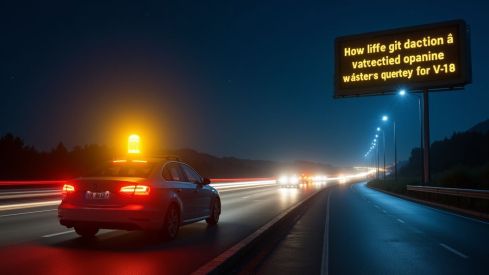
The Spanish Data Protection Agency has published an informative note to resolve drivers' doubts about the use and privacy of the V-16 beacon, a device that will be mandatory in all vehicles starting in 2026 and which can already be used on roads in Catalonia since 2021.
Privacy and device operation
The agency clarifies that the General Directorate of Traffic does not access information about who has purchased each beacon. When a driver activates the device in case of breakdown or accident, the beacon only transmits the vehicle's geolocation to the DGT 3.0 platform. This data serves to alert other road users about the presence of a stopped vehicle, improving safety at conflict points on the road network in Barcelona, Girona, or Tarragona.
The information sent is managed anonymously and is not necessarily linked to the identity of the vehicle owner. The DGT only manages the geolocation information essential for road safety, without storing personal data about drivers.
Manufacturer Responsibility and Emergency Use
The Spanish Data Protection Agency reminds that the manufacturers of the V-16 beacon are responsible for informing buyers about what data is collected and for what purpose. The device remains inactive during normal driving and only transmits data when manually activated in emergency situations.
The system emits a 360-degree visible light signal and automatically alerts about stopped vehicles on the road, facilitating the intervention of emergency services and reducing the risk of secondary accidents on urban and interurban roads.
"You don't have to register" - Guardia Civil
The mandatory use of the V-16 beacon will come into effect in 2026, although its use has already been permitted for three years. The main objective is to reinforce safety in the event of incidents on public roads, without this entailing the processing of personal data beyond the specific location of the affected vehicle.