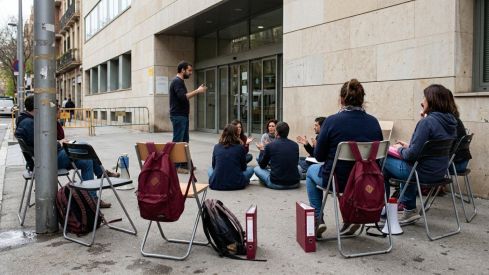
The educational sector in Catalonia has initiated this Wednesday seventeen days of strike called between May 7 and June 5. The majority unions have activated the mobilization to demand salary improvements and working conditions, with protests concentrated mainly in Barcelona.
About twenty teachers have gathered in a symbolic sit-in in front of the Consorci d'Educació de Barcelona. This action marks the start of the protests planned for the third quarter of the school year.
Unions condition the end of mobilizations to a salary agreement
The tension between the administration and the workers' representatives remains high after months of stalled negotiations. Iolanda Segura, spokesperson for USTEC, has been clear regarding the continuation of protests during her address to the media.
"We will only stop the mobilizations if we reach an agreement" - Iolanda Segura, spokesperson for USTEC, Consorci d'Educació de Barcelona
For their part, councilor Esther Niubó has expressed this morning her willingness for both parties to resume dialogue. The head of the department has expressed her desire to reach an understanding that puts an end to the current labor conflict.
The criticism towards the government's economic offer is one of the central axes of the protest. Andreu Navarra, spokesperson for Secondary School Teachers (ASPEPC-sps), has flatly rejected the official proposal.
"The government continues to be entrenched in a country agreement that everyone has rejected, which represents a ridiculous increase. It is laughable that they are raising teachers' salaries by 40 euros" - Andreu Navarra, spokesperson for Professors de Secundària (ASPEPC-sps)
Direct actions in Sants and Sant Andreu paralyze usual activity
The mobilization is not limited to traditional labor strikes. In the Sant Andreu neighborhood, students and teachers from the Institut Martí i Pous have moved teaching to the public street. Classes have been taught in the street accompanied by performances and protest speeches.
In Sants, the protest has adopted a more disruptive format. Six schools in the area have called for a traffic cut at 1 PM in front of the district headquarters. This action seeks to make visible the sector's discontent in a key area of the city.
Ingrid Chavarria, general secretary of CGT Ensenyament, has broadened the focus of the protest beyond the teaching staff. She has pointed out that the grievances affect the entire educational ecosystem.
"Not only teachers suffer the grievances, but all the groups that work in the centers. We need to save public education" - Ingrid Chavarria, general secretary of CGT Ensenyament
The strike call also includes educational leisure staff and Administrative and Service Personnel (PAS), among other groups linked to the centers.
Today's session concludes with an assembly called for this afternoon at the Institut Pau Claris. The meeting will serve to evaluate the follow-up of the first session and coordinate the actions for the coming days.