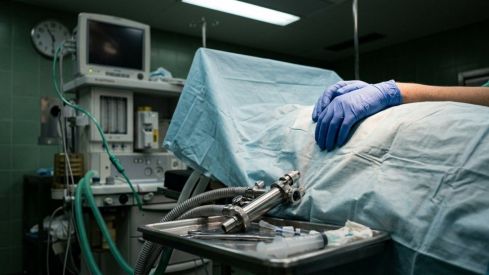
Doctors from 110 services in 27 public and subsidized hospitals in Catalonia have stopped doing extraordinary and voluntary work since June as part of the "Not one more minute" campaign, promoted by Metges de Catalunya. The measure pressures the Department of Health to open negotiations on workload and quality of care.
The halt of these overtime hours comes at a time when CatSalut claims there is no staff shortage, but it already calculates an immediate impact of between 15% and 20% on hospital activity. The tension is concentrated on how to maintain care when part of the system depended on shifts that some specialists extended to about 3,000 overtime hours per year.
Anesthesiology concentrates the strike at Vall d'Hebron, Sant Pau and del Mar
Anesthesiology services are among the main participants in hospitals such as Vall d'Hebron, Sant Pau and del Mar, in Barcelona, as well as other centers in the rest of Catalonia. Their weight in the campaign has a direct effect on areas that are not limited to the operating room.
Irene Bermell, an anesthesiologist and deputy secretary of Metges de Catalunya, explained that the withdrawal of extraordinary activity affects operations, but also other services. Her description included external pre-operative assessment consultations, pain clinics, and invasive examinations that only these specialists can perform.
"Not only will surgical operations cease to be performed, but also some external pre-operative assessment consultations, pain clinics, or invasive examinations that only anesthesiologists can perform" - Irene Bermell, anesthesiologist and deputy secretary, Metges de Catalunya
The campaign began in June with a directive to cut overtime and other voluntary activities outside of ordinary working hours. The union links this decision to a workload that, in some cases, combines usual activity, on-call duties, and added hours outside of shifts.
CatSalut admits that the strike may worsen waiting lists
CatSalut has placed the short-term effect of the protest at between 15% and 20% of hospital activity. This calculation anticipates a broad reach in public and subsidized centers adhering to the campaign.
Alfredo Garcia, director of CatSalut, acknowledged in an interview on 3Cat that the situation causes concern and pointed out that it can be transferred to the health waiting lists. At the same time, he defended that the system does not suffer from a lack of professionals, although the distribution of these staff is not adequate in all areas.
Faced with that pressure, the union maintains that some specialists accumulate up to 3,000 extra annual working hours between ordinary shifts, on-call duties, and extra shifts. That figure is approximately equivalent to double the annual total of a full working day.
Garcia added that CatSalut is open to dialogue with professionals to address the conflict. His assessment incorporates a central piece of data in the negotiation, which is not about increasing the overall staff, but about correcting a distribution that the director himself considers insufficient.