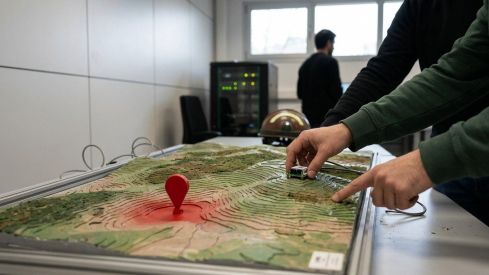
The Universitat Autònoma de Barcelona (UAB) has developed a new forest fire simulator designed to offer more accurate and faster real-time predictions. This technological tool represents a significant advance in preventive risk management, as it allows for the anticipation of complex fire behaviors.
Technical precision and public access
The project is based on open-source software and is available to both public administrations and the general public. Its architecture divides the calculation of critical variables such as meteorology, orography, vegetation, and ignition into separate processes using different servers before integrating the final results.
"We improved the resolution and reduced the simulation execution time"
Affirms Ana Cortés, researcher at the Department of Computer Architecture and Operating Systems of the UAB. The expert emphasizes that this operational improvement is achieved thanks to the application of advanced mathematical methods along with optimized parallel computing techniques.
Satellite Data and Citizen Participation
The platform integrates information from orbital thermal cameras and portable sensors installable in helicopters during real operations. Additionally, it incorporates a mobile application where any user can report sightings of smoke columns to feed the central algorithm with direct observations from the ground.
When the system identifies a new ignition, it immediately sends alerts to the corresponding emergency services. These notices include detailed calculations on propagation speed, probable territorial extent, and possible damage to infrastructure near the initial focus.
"We are finishing defining the moment... we will be able to predict when a fire will change its regime"
Ana Cortés details regarding the future predictive capacity of the model. The main objective consists of determining exactly when these fires will pass to their sixth generation characteristic for gravely altering the upper atmospheric layers.
International Travel and Next Steps
Portuguese firefighters have successfully validated this experimental prototype during specific tests carried out recently. A complete simulation was also carried out, specifically focused on Collserola, to adjust local parameters according to particular Catalan geographical conditions.
The definitive licenses necessary to permit the official use of the computer program are currently being processed. Official estimates firmly point out that all this technology will be fully operational starting next year after overcoming pending stages of additional algorithmic definition.