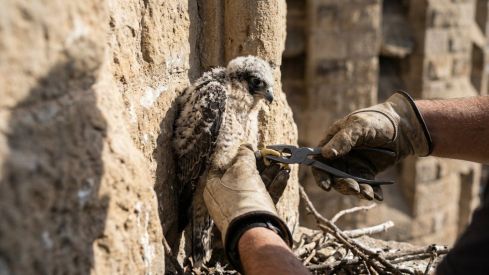
The two peregrine falcon chicks that were born on April 12 in the Sagrada Família already sport identification rings. Technicians carried out this operation this Friday morning, just before the chicks acquire the ability to fly.
The procedure was executed with precision so as not to alter the natural development of the birds. The rings placed combine a specific color with a unique alphanumeric code. This system allows experts to track the origin of the specimens and monitor their future movements through direct observation.
The rings reveal the couple's urban lineage
The identification provides historical data on the genealogy of these urban birds. Sergi Garcia, president of Galanthus, explained the immediate usefulness of this genetic and geographic record.
"Thanks to ringing, we know that the father of the chicks ringed this Friday morning was born on the cliffs of Montjuïc 17 years ago" - Sergi Garcia, president of Galanthus
After the intervention, the technicians returned the chicks to the nest without incident. The basilica keeps its webcam active to follow the animals' evolution. This digital device will allow detecting the exact moment they take their first flight, an event that could occur in a few days or weeks.
This nesting is part of a long-standing conservation effort. The peregrine falcon reintroduction project began in 1999 under the impetus of the Ajuntament de Barcelona and Galanthus Natura. The initiative remains active under the technical leadership of the naturalist entity and the institutional collaboration of the Barcelona council.
A shelter consolidated since 2003
The breeding pair occupies one of the basilica's towers since 2003. The falcons selected this site because it functioned as one of the last available refuges for the species in the urban environment, just before its temporary disappearance from the city.
The religious institution and the municipal government reinforced their commitment three years ago. In 2022, the Barcelona City Council and the Sagrada Família signed a specific agreement. The agreement seeks to guarantee the continuity of the initiative and promote the scientific dissemination of this singular ecological phenomenon.