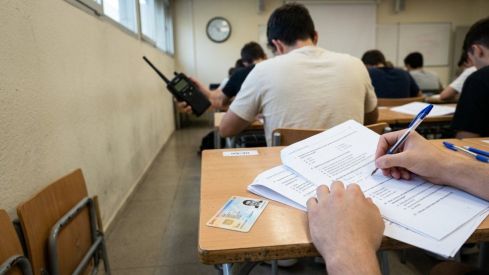
The visit of Pope Leo XIV to Barcelona on June 9 and 10 will coincide with the start of the 2026 university entrance exams, a coincidence that will force thousands of students to arrive with margin due to the mobility restrictions planned in the city.
The tension is in the calendar. The first two days of the PAU, when a key part of the exams is concentrated, will be held at the same time as the pontiff's public events and the associated security deployment, although the Generalitat de Catalunya maintains that the exams will be able to proceed normally.
Núria Montserrat, Minister of Research and Universities, asked for anticipation in travel. The head of the department recommended that "anyone who has to move around Barcelona should do so with some advance notice."
Barcelona will examine 16,000 students in 20 centers during the papal visit
In the city, 16,000 students will take the exams, spread across 20 venues. Eleven of these centers are in the university area of Diagonal, two in the downtown area, and seven in other parts of Barcelona.
The Government has reinforced public transport and maintains permanent contact with the Department of the Interior to reduce the impact of the security device on access to classrooms. The official forecast is that, when the Pope's public events begin, students will already be inside the centers or will have finished.
The 2026 call also comes with a historic maximum of registered students. In Catalonia as a whole, 45,821 students have enrolled to take the PAU, 1,500 more than in the previous year.
The Generalitat will introduce frequency detectors and toughen penalties for fraud
The main operational novelty will be a pilot test with frequency detectors in the examination centers. The controls will be random and will seek to locate unauthorized signals, such as Wi-Fi or Bluetooth, inside the classrooms.
The Generalitat de Catalunya frames these devices as a deterrent. The administration emphasizes that they do not respond to previous cases of cheating and recalls that it was already forbidden to enter with mobile phones, headphones, or digital watches.
Along with this measure, the regulations have been modified so that fraudulent use of an electronic device will result in a zero on the affected exam. Afterwards, the PAU Commission may assess whether to invalidate the student's entire test.
The exam model introduced last year will also remain in effect, with a more competency-based approach, less memorization, and less optionality. In subjects that require writing, the penalty for spelling, grammar, or vocabulary errors will be maintained.
In language, the deduction for errors may reach two points. In the rest of the subjects, the correction may deduct up to 10% of the score for each question.
Around 2,400 teachers will supervise and grade more than 245,000 exams
The organization of the call will mobilize 264 secondary and university professors to prepare 175 exams. The tests will be distributed in about 1,500 classrooms, and the total volume will exceed 245,000 exercises.
In addition, 2,400 teachers will participate as volunteers in the supervision and grading of the PAU, with remuneration 20% higher than last year.