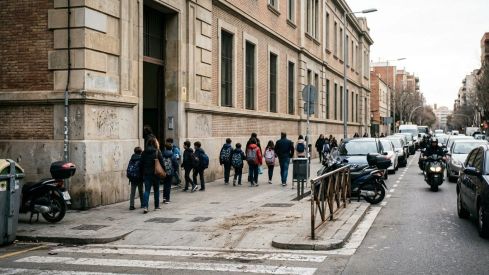
Nitrogen dioxide pollution remains above recommended levels in Barcelona's school environments. All schools analyzed in the city exceed the 10 µg/m³ NO2 limit set by the World Health Organization and 93% also exceeds the 20 µg/m³ value included in the new European directive that must be complied with starting in 2030.
The highest records in Barcelona
The analysis carried out in 15 centers in Barcelona places nine of them above 25 µg/m³ of NO2. The highest records have been detected in the Escola Sagrat Cor Diputació with 35,4 µg/m³, the Escola Fort Pienc with 35,1 µg/m³ and the Escola MDP Bailèn with 34,8 µg/m³.
At the opposite extreme appears Escola Sadako, in the neighborhood of Vallcarca i els Penitents, which registered a concentration of 11.9 µg/m³ of NO2. Despite being the lowest figure among the analyzed Barcelona centers, it also remains above the threshold recommended by the WHO.
A widespread problem in Catalonia
The situation is not limited to the Catalan capital. The study, conducted in 147 centers in 28 municipalities, concludes that 95.2% of Catalan schools exceed the limit recommended by the WHO. The average NO2 recorded in Catalonia as a whole stands at 21.9 µg/m³.
In addition, 90 Catalan school centers exceed the limit of the new European directive. In Sabadell, even, the currently enforceable legal value of 40 µg/m³ is exceeded, a higher threshold than the one that will come into force at the end of the decade.
Warning about child exposure
"It affects many municipalities throughout Cataluña" - Fran Campillo, Societat Catalana de Pediatria
Campillo has also lamented that "this is the air our boys and girls are breathing", in reference to some records that once again place air quality in school environments at the center of the debate on public health and urban mobility in Barcelona and throughout Catalonia.