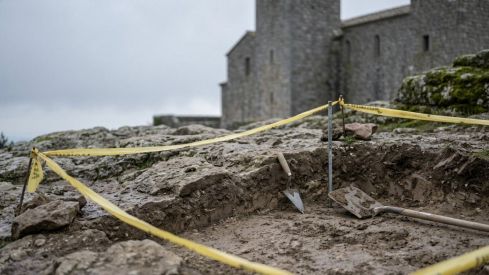
The Diputació de Barcelona has confirmed the discovery of remains of fourteen people in the ancient necropolis located next to the Monestir de Sant Llorenç del Munt, on the summit of La Mola. The bones, found in the vicinity of the monastery, are already in a laboratory in Mataró for their analysis, dating, and anthropological study.
The discovery not only expands knowledge about the early stages of the monastery, but also forces a retouching of the planned layout for the enclave. The Diputació will have to modify the Sustainable Future Plan of La Mola to incorporate remains that some could date back to the 10th century.
Only two or three bone sets are preserved intact
The first works have allowed the identification of remains of fourteen people in the ancient necropolis near the monastery, although the state of conservation is uneven. Only two or three of the bone sets have arrived intact at the laboratory, where specialists will examine their chronology and physical characteristics.
Only two or three bone sets are preserved intact.
The analysis in Mataró must specify the dating of the remains and determine age, sex, possible traumas, and pathologies. Part of that material could correspond to the 10th century, a reference that would place some burials in the early stages of Sant Llorenç del Munt.
The Diputació will carry out fifteen tests around the summit of La Mola
To protect the area, the Diputació has already cordoned off the points where the remains appeared and thus avoid the deterioration of possible additional findings. The next step will be to more precisely delimit the area of the necropolis and expand the search in the immediate surroundings of the cim de la Mola.
The Diputació will carry out fifteen tests in the coming weeks.
Those surveys will be distributed across different areas around the summit, with the objective of defining the real extent of the funerary space before closing the archaeological phase. In parallel, the institution will develop in the coming months a Master Plan for the Monastery of Sant Llorenç del Munt, cataloged as Asset of Cultural Interest.
The review of the planning also affects the general framework of action on the Mola, because the discovery will force the modification of the Sustainable Future Plan. Once the archaeological phase is finished, the Diputació will also address how to disseminate the remains and the results of the research.
The institution expects to have the conclusions of the study before the end of the year.