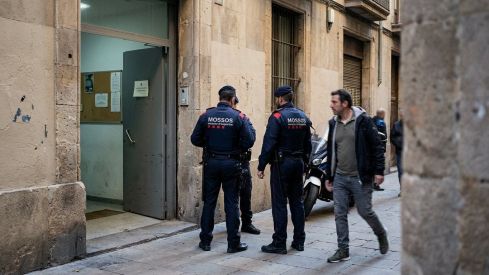
Montserrat Escudé has taken office as the new chief superintendent of the Mossos d'Esquadra in the Ciutat Vella Basic Police Area and has defined her operational strategy with a clear focus on the recovery of public safety. The police leader has stressed that the absolute priority lies in the fight against petty crime, theft, and robberies with force and intimidation that directly affect the streets of the old neighborhood.
Anti-riot strategy and arms control
Escudé has detailed that the police action is based on a constant generation of intelligence and on surgical communication with the courts to facilitate more efficient judicial measures. The force maintains the Daga plan active, an initiative designed to neutralize the proliferation of knives and sharp objects. The intendant has recognized that a recent trend has been detected to carry these utensils in public places without justified reason. Faced with this situation, the police strategy foresees intensifying routine checks and expanding search operations to proceed with immediate seizure. A strict doctrine will be applied where the aim is not only to prevent the effective use of the weapon but also to discourage its mere possession in open spaces.
"Fighting this petty crime is an absolute priority to guarantee Barcelonian safety" - Montserrat Escudé, Chief Superintendent of the Mossos d'Esquadra
The management of drug dens constitutes another priority front within the district. The mayor has explained that the drugs seized in these interventions usually lack statistical relevance from a purely judicial perspective but possess incalculable value for guaranteeing residential tranquility. The presence of a consumption hotspot in the same building causes a devastating effect on coexistence and the perception of security among residents.
Neighborhood impact and prevention as a central axis
For the Mossos d'Esquadra, it is as crucial to recover urban harmony and allow residents to enjoy their homes without disturbances as it is to achieve large seizures of narcotic substances. This preventive philosophy also extends to the care of vulnerable groups. The superintendent has pointed out that many people affected by situations of exclusion do not file complaints when their basic daily needs are met. The biggest institutional challenge lies in deploying a forceful preventive machinery to reduce the hidden figure of gender-based violence cases in an area marked by structural poverty. Many women and minors are unaware of their fundamental rights and require direct support to identify and report abusive behaviors.
The mayor concluded that the ultimate goal is to actively help the population detect and report those situations that constitute violence, thus consolidating institutional trust and guaranteeing peaceful coexistence in the urban environment.