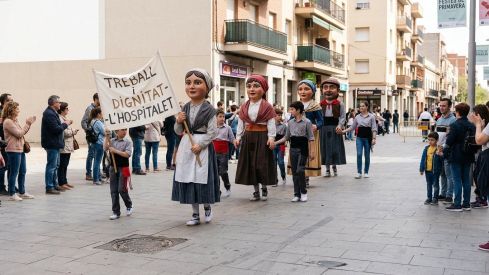
The Gegantes Obreres de L'Hospitalet will debut this Saturday in the Festes de Primavera with a first participation in the children's cercavila of colles geganteres through the city center. The new group is part of the children's colla gegantera of the popular culture entity TRO and is made up of two gegantones and six gegantes manotes.
The figures are born with a clear will of memory and recognition. They pay homage to the women who worked in the textile factories of L'Hospitalet, in historic spaces such as Tecla Sala, Can Vilumara or Can Trinxet, where for decades many neighbors sustained an essential part of the local industrial activity in very harsh conditions.
"We wanted to vindicate the working woman in the city's textile sector because they were not well treated and had very bad working conditions" - Pilar Martínez, head of the Gegantes Obreres de L'Hospitalet group
A collection that spans ages and textile trades
The group has been conceived from characters that represent vital stages and specific jobs linked to the textile industry. Xinxeta, Xinxa and Xinxona embody the same woman at three different ages, while other figures give name and body to factory trades.
"La Xinxeta is the small gegantona and reflects child labor, because the girls of that era also worked in the factories" - Pilar Martínez, head of the Gegantes Obreres group of L'Hospitalet
Alongside them appear the Teixidora, the Nuadora, l'Ordidora and the gegantona Aprenenta Bitllaire, all linked to tasks specific to the sector. Also noteworthy is the figure of the Sindicalista, who carries a white flag as a reference to the struggle to improve the working conditions of the female workers.
Planned route through the center of L'Hospitalet
Four of the gegantones will participate in the children's parade this Saturday morning within the program of the Festes de Primavera. The gegants' planting is scheduled at 10:00 a.m. in the plaça del Repartidor.
From there, the route will advance along the carrer de Tarragona, the rambla Just Oliveras, the carrer Enric Prat de la Riba and will end in the plaça de l'Ajuntament, where the dance of the participating colles will be held. The premiere of these figures will thus incorporate a new look at the popular culture of the city, linked to its working-class past and to the role of women in the industrial history of L'Hospitalet.