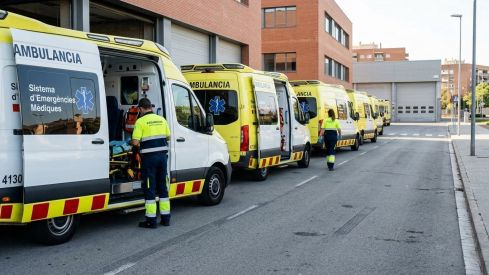
Barcelona will incorporate 286 new ambulances from this Wednesday with the start of the deployment of the new care and health transport model of the SEM in the Barcelona Health Region. The measure is part of the new public tender for health transport in Catalonia and seeks to improve care and reduce response times in one of the areas with the most care pressure in the country.
The implementation will be launched in two phases to guarantee the continuity of the service. In this first stage, the new vehicles planned to reinforce both urgent and non-urgent activity within the city come into operation.
More ambulances in the urgent and non-urgent network
In urgent health transport, basic life support ambulances increase from 44 to 57 in moments of maximum activation. This represents an increase of 30%. At the same time, the device adds more than 55,000 additional service hours per year.
In the non-urgent scope, the number of ambulances grows from 174 to 209. These are 35 more units, with an increase of 20%. In addition, 18 newly created units are incorporated, designed to support both urgent and non-urgent health transport.
The deployment also includes the renovation of two units that provide service to the Organització Catalana de Trasplantaments for the entire Catalan territory.
Second phase planned for June
The second phase is set for next June 3. At that time, new advanced life support vehicles will be incorporated and new electromedicine will be introduced. Also planned is a strategic relocation of the units within Barcelona to better adjust the response on the ground.
A city with high healthcare demand
Barcelona registers more than 577,000 incidents per year, a figure that translates into nearly 1,600 per day. The Catalan capital also concentrates more than 25% of all urgent incidents in Catalonia, which makes it one of the central points of the healthcare emergency system.
Of that volume of notices, more than 47%, about 750 per day, require the mobilization of an in-person resource, either an ambulance or a home doctor. The remaining 53% is resolved non-in-person.
The objective of the new deployment is to reinforce the operational capacity of the SEM in Barcelona in a network that assumes every day hundreds of in-person activations and a very relevant part of the healthcare pressure of all Cataluña.