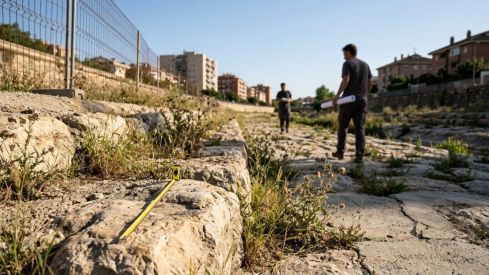
The Terrassa City Council has initiated the drafting of the strategic plan for renaturalization and adaptation to climate change of the Palau, les Arenes, and Rubí streams, a document that will define how to intervene in these urban corridors from 2028 onwards.
The project starts from a limitation that conditions the entire action. The city council wants to integrate the streams into the city and connect them with the neighborhoods, but it will not be able to turn their beds into parks or activity spaces as happens in the Besòs because that space, according to the drafting team, must be reserved for the passage of water.
Jordi Ballart, mayor of Terrassa, presented a roadmap that will extend until December 2027, when the definitive plan will be delivered. The drafting contract costs 361,000 euros.
The plan will arrive in December 2027 and the works will start from 2028
The planned calendar includes a first participatory session in September with the Rieres Commission. Afterwards, in December, the drafting team will deliver a first draft of the document.
Already in the spring of 2027, the process will incorporate the contributions of the Catalan Water Agency, of the Rieres Commission itself, and of the different municipal departments. With that work, the City Council plans to close the definitive version at the end of that same year.
Ballart framed the action within a long-term transformation for the city and argued that the streams should no longer be seen solely as a barrier or as drainage channels. The mayor proposed that the objective is to study their possibilities from a hydraulic, environmental, and social point of view.
"For decades, our streams have been perceived as an obstacle. What we want is to re-naturalize them and integrate them into the urban fabric and thoroughly study their possibilities at the hydraulic, environmental, and social levels" - Jordi Ballart, mayor of Terrassa
The riverbed will be cleared and the project will focus on the banks
The main technical clarification was provided by Jesús Arcos, architect of the company AldayJover, in charge of the drafting. His approach rules out intervening within the riverbed with park or leisure uses.
"We cannot occupy the space of the stream's channel to do anything, as this space belongs to the water" - Jesús Arcos, architect at AldayJover
From that limit, the study does open the door to actions on the margins and in other nearby areas. Arcos raised the possibility of creating a longitudinal corridor or promenade that connects the neighborhoods through which the Palau, les Arenes, and Rubí streams pass.
The mayor differentiated the future model of Terrassa from the Besòs River Park due to the more intense flow of local streams. He also linked the plan to the actions already carried out this year in the les Arenes stream, where the City Council has carried out wall repairs and vegetation removal.
Ballart also maintained that Terrassa wants to develop its own intervention model for these urban spaces. The definitive plan, with a cost of 361,000 euros, must be delivered in December 2027.