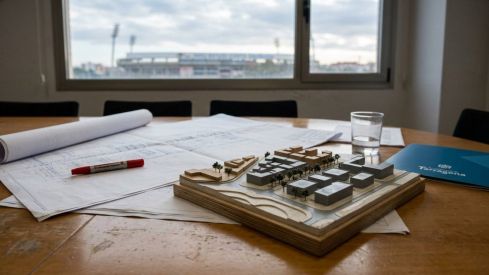
The plenary session of the Tarragona City Council has approved the urban development plan for the new Nàstic neighborhood, planned next to the Nou Estadi, with the favorable votes of PSC, ERC, Junts per Catalunya, and three non-attached councilors. En Comú Podem, PP, and Vox abstained in a vote that now allows the consolidated text to be sent to the Urban Planning Commission of Camp de Tarragona for final approval.
The main discussion has not been about whether there will be housing, but about how much should be reserved for social housing. The plan sets 525 apartments and reserves 161 units for social housing, 30%, although the Generalitat will still have to rule on whether this percentage is sufficient or if it should be raised to the 40% foreseen by the Territorial Sectorial Housing Plan.
The plenary session approves 525 homes and leaves the dispute over the protected percentage open
The Councilor for Urban Planning, Nacho García Latorre, celebrated that "finally this growth sector is entering the final stretch of its processing." The councilor also maintained that the municipal government is acting to respond to the housing access problems in Tarragona.
"We are doing what is necessary to solve the city's housing problems" - Nacho García Latorre, Councilor for Urban Planning, Tarragona City Council
The City Council owns 40% of the land included in the area and does not rule out increasing social housing up to 38% by revising densities. García Latorre argued that bringing the reserve directly to 40% "would have caused legal problems."
From ERC, Xavier Puig called for "maximum ambition" to take advantage of the redistribution of plots and try to bring the project closer to that 40%. Puig maintained that there is no report that proves the unviability of the increase, although he admitted that this option would involve significant costs and possible claims of legal uncertainty from private owners.
The redistribution of plots concentrates doubts about social housing and land management
En Comú Podem placed one of its main reservations at that point. Jordi Collado warned that the redistribution of plots will be decisive in determining how the plots are distributed and what real margin protected development will have within the project.
"The temptation is to make it too easy for the private sector, and if we don't watch out, we'll end up in a dead end" - Jordi Collado, spokesperson for En Comú Podem, Tarragona City Council
Collado also rejected that the council concentrates all the VPO plots. In his opinion, that formula would not by itself resolve the sector's balance.
Junts per Catalunya, for its part, regretted that the project did not go ahead with unanimous support. ERC framed the action as the last major growth sector in the Llevant area, an argument with which it defended using up the affordable housing margin before final approval.
The plan reaches the final phase with the Nou Estadi mobility still pending
The surroundings of the Nou Estadi also suffer from a mobility deficit on match days, an issue that has been highlighted during the neighborhood's processing. That point affects vehicular access and parking in an area that will have to absorb both sporting activity and the new residential use.
Now the municipal government is preparing two actions for that area. One involves creating parking lots and the other involves improving the old national road route to enable a park-and-ride next to the stadium.
The next step is in the hands of the Comissió d'Urbanisme del Camp de Tarragona, which will have to decide whether the 30% reservation is sufficient or if the new Nàstic neighborhood should approach the 40% of protected housing proposed by the Territorial Sectorial Housing Plan.