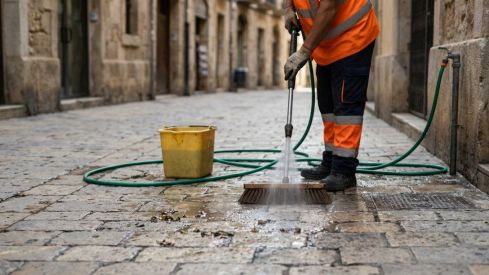
The Tarragona City Council will maintain the brigade created last August to remove pigeon droppings from public spaces while it waits for the joint plan with the Port Authority to start yielding results. The team has already cleaned more than 350,000 linear meters of streets and squares and has accumulated almost 5,000 hours of service.
The paradox of the operation is that the municipal reinforcement will remain active at least during the extension of the current contract, which amounts to nearly half a million euros and ends in December, because the effects of the strategy on the bird population will take up to two years to be noticeable. In some areas, such as Girona street, the dirt reappeared an hour after the brigade passed.
The brigade cleaned 350,000 meters and operated in streets in the center and several neighborhoods
Sonia Orts, councilor for Citizen Relations, Cleaning, Mobility, and Civil Protection, explained that the specific device is not part of Urbaser's ordinary service. The council launched it through an employment plan for the unemployed, promoted with Tarragona Impulsa, and coordinates it with the concessionaire to avoid duplication.
The service consists of nine laborers and one supervisor, divided into three teams that work from seven in the morning to two in the afternoon. For manual removal, they use hoses connected to municipal irrigation outlets, as well as brooms and buckets.
The actions are scheduled weekly with an interactive technical map that locates the areas with the most accumulation and is corrected based on incidents and bird behavior. The work radius includes sections between the ramblas, Girona street, Passeig de les Palmeres, Sant Francesc, Estanislau Figueres, Pau Casals, Roger de Llúria, Armanyà, or Méndez Núñez, as well as squares in Bonavista, Sant Salvador, Torreforta, and Sant Pere i Sant Pau.
The shock plan acted in 81 points while the port prepares changes in warehouses and docks
Municipal studies registered densities of up to 7,000 pigeons per square kilometer in some neighborhoods and an estimated total population of over 20,000 birds. With this scenario, the City Council executed a shock plan in 81 critical points in the center.
The intervention involved an investment of 23,230.79 euros to install approved deterrent systems such as spikes, steel cables, silicone sheets, methacrylate plates, and nets, especially on Rambla Nova, Rambla Vella, Part Alta, and commercial streets. Orts indicated that the municipal government is now reviewing which points need modification and plans to re-contract part of these installations in other areas.
In addition to cleaning, the council is taking action with the removal and sanitation of nests, the placement of nets, requests to private owners, and selective capture systems. The trial with contraceptive feed was unsuccessful due to the difficulty of ensuring that the birds consumed it daily.
In parallel, the City Council and the Port Authority are working together at a bilateral meeting. The port has already presented a plan that includes improvements in the sealing of warehouses, more cleaning on docks, new logistical protocols, and training for workers.
Residents report issues via WhatsApp and request more sanctions for those who feed birds
Miguel Cruz, representative of the Federation of Neighborhood Associations of Tarragona at the cleaning committee, detailed that residents communicate incidents through a WhatsApp group shared with a municipal technician and a Urbaser manager. He also called for stricter sanctions for incivility and against those who feed pigeons.
The Environment Department has added indirect control measures with the nesting of a pair of peregrine falcons at the Port Authority and the installation of nine nesting boxes for birds of prey, including peregrine falcons, kestrels, scops owls, and barn owls.
Orts set a maximum timeframe of two years to verify if the global strategy is working on the ground, and until then, the council will expand the actions of the cleaning brigade and nest removal.