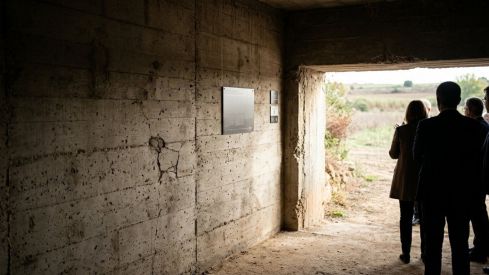
The municipality inaugurated its Memory Spaces this Saturday in an event led by the President of the Parliament, Josep Rull, and the President of the Diputació de Lleida, Joan Talarn. The event also brought together the mayor Eduard Murgó, the president of the Consell Comarcal del Segrià, David Masot, and the territorial director of the Department of Justice and Democratic Quality, Anna Miranda.
The opening of this memorial route places in a small town a part of the recovery of the wartime and repressive past that is often concentrated in capitals and large facilities. Joan Talarn precisely defended this territorial distribution of memory and maintained that these spaces must also reach smaller municipalities.
Rull opened the event at the Town Hall and the delegation unveiled a plaque on Mestra Tapias street
The institutional day began at the Town Hall, where Josep Rull signed the town's Book of Honor. Afterwards, the delegation moved to Mestra Tapias street to unveil the inaugural plaque before the planned speeches in Plaça de la Creu.
In his speech, Joan Talarn defined the Memory Spaces as a "collective and permanent duty" and presented them as a tool to preserve dignity and history. The president of the Diputació de Lleida added that these places allow older people to feel that their pain and their experience have not been in vain or forgotten.
"Memory cannot remain concentrated only in capitals or large facilities" - Joan Talarn, president of the Diputació de Lleida
Talarn linked this idea to the institution's commitment to historical memory policies and to the recovery of spaces linked to repression and democratic struggle. His message focused on the role that the municipalities of Segrià can play in preserving this legacy.
The recovery rehabilitated two republican casemates and signposted a Francoist position next to the Segre
After the institutional event, attendees visited the bunker at the Era de Cal Pubillet. There, technicians from the Civil War Spaces Research Group explained on-site the recovery work carried out in the area.
The intervention has made it possible to rehabilitate two republican defensive casemates and also to signpost a Francoist casemate located next to the Segre river. The project thus incorporates vestiges of both sides within the same local memory itinerary.
In addition to the war front, the performance also highlights the figure of teacher José de Tàpia, promoter of the local school. This element expands the tour beyond military structures and connects it with the educational history of the municipality.
The final point of the visit was at the bunker of the Cal Pubillet era, where technicians from the Civil War Spaces Research Group detailed the recovery of the two Republican casemates and the marking of the Francoist position next to the Segre River.