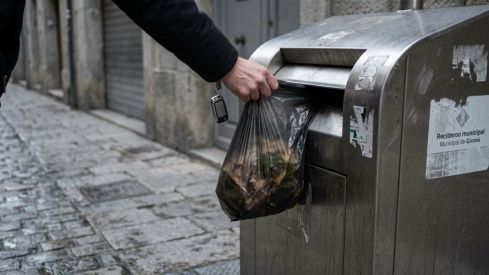
Waste management continues to be a central focus of the mandate in Girona, where the municipal government has introduced changes in 2026 to the closed container system while keeping other fronts open, such as the fee, the labor dispute that ended in a strike at the beginning of the month, and the differences between neighborhoods regarding different collection models.
The main friction lies in the fact that the city coexists with different rules for disposing of garbage depending on the area. While sectors with closed containers have reverted to a model with one container per fraction accessible every day and at any time, neighborhoods with door-to-door collection and the temporary areas of Barri Vell and Mercadal remain subject to more limitations.
Girona reinstated daily opening for closed containers
The local executive, led by Guanyem Girona, has tweaked the system inherited from the previous mandate this year. The most visible change has been replacing exclusive card access with a system that adds a keychain and an app to open closed containers and also temporary areas.
In addition, the city council has re-established one container per fraction open every day, instead of the initial multi-fraction model, which required depositing each waste on specific days. The modification affects the daily operation of areas with closed containers and reduces one of the complaints generated by the previous rollout.
This adjustment, however, has not eliminated the imbalance between neighborhoods. The city simultaneously maintains closed containers, temporary areas in Barri Vell and Mercadal, and door-to-door collection, so that disposal days and times change depending on the point in Girona.
Junts demanded changes to door-to-door collection in early April
Neighborhood protests have concentrated in the door-to-door areas and temporary areas, where various residents denounce a comparative grievance compared to those who have closed containers with daily access. The criticism focuses on the operational difference between systems that coexist within the same city.
In early April, Deputy Mayor Gemma Geis, from Junts, positioned the immediate flexibility of door-to-door collection as her group's central demand. Her position coincided with a moment of maximum pressure on waste policy, which has become one of the most sensitive issues of the mandate.
In parallel, the Department of Climate Action, held by Guanyem, has expanded the emergency areas in sectors with door-to-door collection and in temporary areas. In these locations, it has placed closed organic and residual waste containers to provide an additional outlet outside the ordinary schedule.
The measure introduces a partial correction, because these areas can be used with a card at any time. Even so, it does not fully equalize the conditions with the rest of the systems and maintains differences in use between neighborhoods in Girona.
The limit set for these emergency areas is 52 uses per year with a card, and their installation has been done by reusing spaces where there were previously smart bins that were no longer needed.