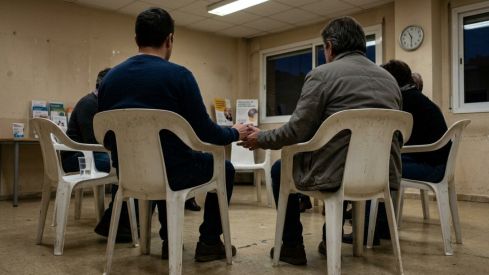
Al-Anon meetings in Figueres bring together family members and friends of people with alcohol problems every Thursday who seek mutual support to face a situation that also affects their daily lives. The group meets at seven in the evening at the Figueres civic center, on carrer Joan Subias i Galté.
The paradox that runs through these sessions is that those who do not drink end up living dependent on the illness of others. Marta, a pseudonym for a participant who has been attending for six years, summarizes this emotional dependence by explaining that many families cannot detach themselves from the sick loved one and become trapped by what they do or do not do.
Families come to Figueres because the illness also disrupts their lives
Al-Anon functions as a mutual support community among people who share the same problem at home or in their immediate surroundings. Its model is based on a twelve-step program coordinated by peers, without the intervention of healthcare professionals during the sessions.
This approach begins with an explicit admission of personal limitation. The first step proposes "admitting that we were incapable of facing alcohol alone and that our lives were totally unmanageable," a formulation that focuses on the impact addiction has on the entire close-knit group.
Marta describes this experience from the inside. Anything they do or don't do affects us, she states, recounting how the family's attention is absorbed by the person with alcoholism to the point of putting their own daily lives in the background.
"Our problem is the great emotional dependence we have on the sick loved one because we are unable to detach ourselves from them. Anything they do or don't do affects us, we don't live, we are waiting on them" - Marta, Al-Anon participant in Figueres
The organization adds a specific branch for minors and young people. Alateen is aimed at those who live with alcoholism in the domestic environment during childhood or adolescence.
The group establishes anonymity and the three Cs as the basis for sessions
Internal functioning rests on the absolute confidentiality of what is shared in each meeting. This framework of anonymity explains why public testimonies from the group appear with pseudonyms, even when they recount long processes of accompaniment.
Sara, another member also identified by a fictitious name, explains that the wear and tear ends up affecting all areas of personal life. She recounts that attention shifts towards constant help for the other person, with the feeling of ceasing to think about oneself.
"In the end, it affects your life a lot, you stop thinking about yourself and only focus on what you can do to help them, it's horrible, a hell, but we are here fighting" - Sara, member of Al-Anon in Figueres
Along with the twelve-step program, the entity disseminates the principle of the three C's. The idea is summarized in three limits for the family member or loved one, who has not caused the illness, cannot control it, and cannot cure it either.
The Figueres group carries out its activity in a context where alcoholism is socially addressed as an unrecognized officially mental and chronic pathology, while the system prioritizes symptomatic treatment over comprehensive patient care.
In Figueres, meetings open to family and friends of people with alcohol problems are held every Thursday at 7:00 PM in the Figueres civic center on Joan Subias i Galté street.