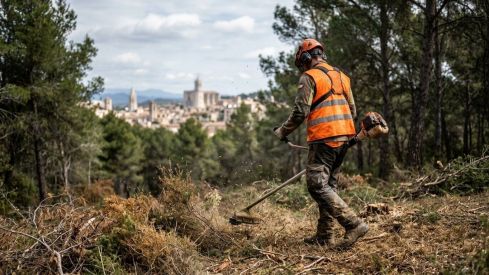
The selective forest management works to curb the arrival of large fires to the urban area of Girona and its surroundings have begun this weekend on an area of 90 hectares distributed among Girona, Quart, Sant Julià de Ramis and Palol de Revardit.
The action seeks to directly protect about 150,000 people in the Girona-Celrà confinement axis, a strip designed to reduce the risk of an extreme fire reaching neighborhoods, homes and infrastructures in an area with forest mass very close to inhabited spaces.
Girona concentrates works in three sectors close to the urban fabric
In the Gerundense capital, the tasks are being executed in Girona Nord, Polvorí-Font de la Pólvora and la Creueta, three areas where forest continuity brings the risk closer to the urban perimeter.
The Departament d'Agricultura, Ramaderia, Pesca i Alimentació de la Generalitat reported on Saturday the start of these actions, which also extend to the municipal terms of Quart, Sant Julià de Ramis and Palol de Revardit.
The operators act with brush clearing, tree thinning, pruning and management of plant remains. The objective is to reduce the continuity of forest fuel so that, if a fire is declared, the fire loses intensity before reaching inhabited areas.
The Generalitat foresees 14 axes to protect more than 870,000 people
The infrastructure is part of the Estrategia de gestión forestal sostenible de Catalunya and was conceived by the Bombers de la Generalitat as a prevention tool against high-intensity fires.
In addition to the Girona-Celrà corridor, the Govern has delimited 14 confinement axes throughout Catalunya. In total, they cover more than 223,000 forest hectares and are planned to protect more than 2 million hectares of territory.
The actions, indicated the Generalitat, are compatible with environmental values and are executed outside the period of maximum fire risk, when the work windows allow intervention with less impact and greater safety.
In the case of the Girona-Celrà axis, the planning sets a direct coverage over the surroundings of about 150,000 people distributed in an area where an extreme fire could compromise neighborhoods, homes and basic infrastructures.