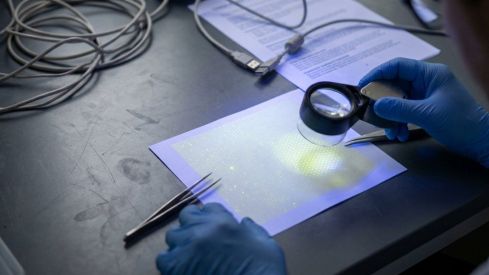
Color laser printers have incorporated an invisible tracking system for decades that allows the serial number of the equipment and the exact date and time of printing to be identified. These marks, known as tracking dots or MIC, measure 0.025 millimeters, are yellow, and are printed on paper without most users detecting them.
The paradox is that a technology designed to combat banknote counterfeiting ended up becoming a tool capable of tracking leaked documents and compromising whistleblowers and journalistic sources, while millions of people continue to print without knowing they are leaving this trace.
The technology was born in the eighties to curb counterfeiting
Xerox and Canon developed this system in the mid-1980s. The initial objective was to make it difficult to counterfeit banknotes using color laser printers, which even then opened a new front for the authorities responsible for prosecuting such crimes.
The existence of these codes did not become publicly known until 2004. That year, Dutch authorities used them to track counterfeiters who had used a color laser printer.
A year later, the Electronic Frontier Foundation deciphered the patterns and confirmed that they stored two specific pieces of data: the printer's serial number and the exact moment the printing had been done.
Not all machines use the same method. Inkjet printers do not usually use this mechanism, although they may incorporate other identification systems.
Researchers found patterns in more than one hundred models from 18 manufacturers
Detecting these dots is not easy to the naked eye. Locating them requires high-resolution scanning, color inversion, ultraviolet light, a high-power magnifying glass, or a USB digital microscope.
Researchers from the Technical University of Dresden analyzed more than one hundred models from 18 manufacturers and developed tools to extract, analyze, and anonymize these patterns. This work made it possible to verify the extent to which tracking is widespread in commercial printers.
Stephan Escher, a computer scientist, summarized this scope in an interview with Deutschlandfunk.
"Practically all modern color laser printers incorporate some type of tracking system" - Stephan Escher, computer scientist, Deutschlandfunk
The same researcher added that manufacturers rarely inform users about the existence of these codes or how they work. This lack of information is one of the points most criticized by privacy organizations.
These entities question the lack of transparency because the technology allows tracking leaked documents and identifying people who report irregularities or provide information to journalists.
Today, despite the system having been in use for more than forty years, millions of people print without knowing about this invisible digital fingerprint that is fixed on each document through yellow dots of 0.025 millimeters.