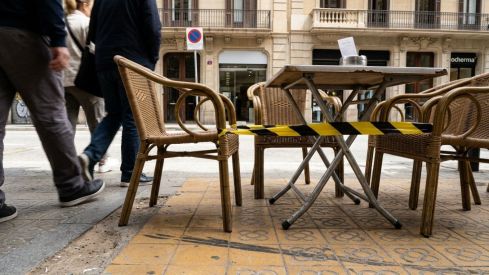
Barcelona is close to 7,000 active terrace licenses for bars and restaurants after a 6.1% increase in the last three years. Between 2022 and 2025, the Barcelona City Council granted 1,192 new authorizations and denied 1,117, in a scenario of contained expansion but with a very high volume of administrative and sanctioning activity.
The paradox appears in the territorial distribution and in the municipal response. While the city maintains an average of four terraces per 1,000 inhabitants and l'Eixample concentrates one third of all current licenses, the council opened 2,400 sanctioning proceedings in 2025 and two districts, l'Eixample and Ciutat Vella, accumulate more denials than grants.
l'Eixample concentrates 2,296 licenses and exceeds the average with 8.3 terraces per 1,000 inhabitants
The map of terraces in Barcelona places l'Eixample far ahead of the rest of the districts. It has 2,296 current licenses, which is equivalent to approximately one third of the city's total, and registers a density of 8.3 terraces per 1,000 inhabitants, well above the municipal average.
Behind it are Sant Martí with 1,096 active licenses and Sants-Montjuïc with 678. Ciutat Vella has 568, Sant Andreu with 467, Sarrià – Sant Gervasi with 466, Nou Barris with 423, les Corts with 382, Horta with 279, and Gràcia with 244.
In density, Ciutat Vella reaches 4.9 terraces per 1,000 inhabitants and Sant Martí reaches 4.3. At the opposite extreme, Horta-Guinardó and Gràcia are below two terraces per 1,000 inhabitants.
The pace of new grants has also been decreasing. In 2022, the city council granted 486 licenses, in 2023 and 2024 there were 243 in each year, and in 2025 they decreased to 220.
Sants-Montjuïc is the district that accumulated the most new licenses between 2022 and 2025, with almost 20% of the total granted in Barcelona. Sant Martí received 200 new licenses, l'Eixample 196, and Sarrià – Sant Gervasi 109.
At the same time, l'Eixample and Ciutat Vella registered more denied licenses than granted ones during that same period. This overlap between high concentration, new requests, and restrictions summarizes a large part of the debate opened in the city about the use of public space.
Barcelona opened 11,033 proceedings since 2022 and l'Eixample led sanctions in 2025
The inspection pressure also draws differences between districts. In 2025, Barcelona initiated 2,400 sanctioning files linked to terraces, a figure similar to 2024 but lower than those of 2023 and 2022.
Between 2022 and 2025, the total reached 11,033 files. The most common infractions were the installation of unauthorized elements, exceeding occupation limits, reducing sidewalk width with serious disturbance, and operating without a license.
In 2025, l'Eixample led the files with 967, followed by Ciutat Vella with 539 and Sant Martí with 320. Three years earlier, in 2022, the largest volume had been concentrated in Ciutat Vella, with 1,126 files, above the 1,077 in l'Eixample.
Roger Pallarols, director of the Gremi de Restauració de Barcelona, argues that terraces are part of the DNA of Barcelonians and are essential for the operation of restoration businesses. He also maintains that the 6.1% increase since 2022 is moderate and that the city can still absorb more installations.
"More than 80% of terraces have four tables or fewer" - Roger Pallarols, director of the Gremi de Restauració de Barcelona
Pallarols attributes part of the conflict to what he defines as a culture of obstruction within the Administration and a lack of trust in a sector that, he claims, represents 6% of direct GDP. Regarding municipal inspection activity, he adds that it is absolutely out of control.
From the neighborhood movement, Ana Menéndez, vice president of the FAVB, frames the debate in the opposite direction. She questions how far terraces will grow, which in her opinion, colonize public space, and calls for more municipal control.
"We believe we should aim for a decrease" - Ana Menéndez, vice president of the FAVB
The difference between both positions coincides with a city where the distribution of terraces is very unequal. The highest figure remains in l'Eixample, with 2,296 active licenses, compared to 244 in Gràcia.